Your Sudoku Solve, Visualized: Meet the Progress Report
Most online Sudoku results end with two numbers: your time and your mistakes. That tells you how the puzzle ended, but almost nothing about how you solved it.
Our new Sudoku progress report keeps the interesting part. After every finished Sudoku Daily or Sudoku Unlimited puzzle, you can open a move-by-move view of your pace, hints, mistakes, revisions and route through the grid. It is available whether you solve the puzzle or run out of mistakes.
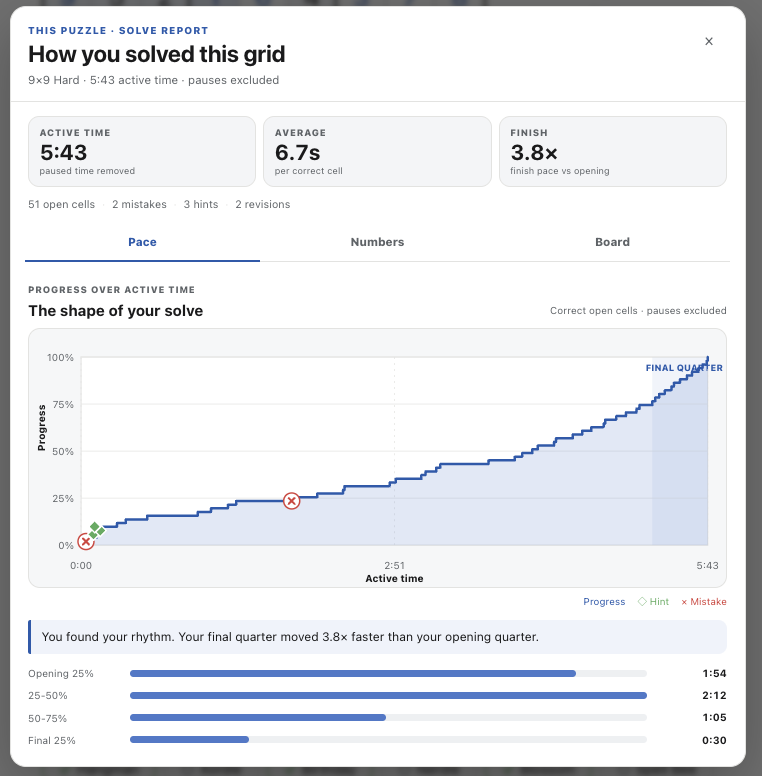
The image above is a real 9×9 Hard game from our team, not a staged demo. The opening was rough. Then the grid started to make sense, the solve found a rhythm and the last quarter went by in 30 seconds. The report makes that shift visible at a glance.
What this Sudoku progress chart reveals
This puzzle had 51 open cells and took 5:43 of active solving time, or an average of 6.7 seconds per correct cell. Those summary numbers are useful, but the shape of the line tells the better story.
The first quarter took 1:54. The second took 2:12, so the middle of the puzzle was even less comfortable than the opening. Then the pace changed: the third quarter took 1:05, and the final quarter took only 30 seconds. That finish was 3.8 times faster than the opening pace.
Because each step represents another correct open cell, the accelerating finish gives the chart an almost exponential shape. You can see the exact moment the solve stops feeling uncertain and starts flowing.
The chart also leaves the messy parts in place. Green diamonds mark hints, red crosses mark mistakes, and drops or flat sections preserve backtracking and pauses in progress. In this game, the early hint markers and two mistakes sit right where the line was moving slowly. They are part of the solve, so the report does not hide them.
Three ways to review how you solved the grid
The progress curve is only the first of three views in the report.
Pace: see when the puzzle clicked
The Pace tab charts correct cells against active time. It also splits the solve into four equal progress phases, making it easy to compare the opening, middle and finish without guessing from the curve.
This is the fastest way to answer questions such as:
- Did I spend most of my time getting started or breaking through the middle?
- Did one mistake interrupt a good run?
- Did a hint unlock the grid, or did I still need time afterward?
- Was my finish actually faster, or did it only feel faster?
Numbers: find the digits that slowed you down
The Numbers tab shows when each digit first appeared and when its final open cell fell into place. A puzzle can feel generally difficult when the real issue was narrower: perhaps every 7 landed late, or a single missing 4 held up two boxes.
Reviewing the number timeline can suggest what to scan first next time. If one digit consistently finishes late, try checking that number across all nine rows, columns and boxes before reaching for a more complicated technique.
Board: retrace your solving route
The Board tab turns the completed grid into a solve-order map. Lighter cells were entered early and darker cells came later. Given cells and hinted cells stay labeled, so you can see whether you worked box by box, followed one digit across the board or jumped between several promising areas.
There is no single correct route through a Sudoku. The value is recognizing your own pattern. A scattered opening may show that you were collecting easy singles. A tight cluster followed by a rapid sweep may reveal the box or digit that unlocked everything else.
A useful report even when you do not finish
A failed Sudoku attempt still contains real progress. That is why the report does not disappear when a round ends without a win.
For an unfinished attempt, the summary shows the best point you reached and how many correct cells remained at the end. The same timeline preserves hints, mistakes and revisions. Instead of receiving only a failure screen, you can see how far you got, where the attempt changed direction and what to watch for in the next puzzle.
This matters for harder grids. Improvement rarely looks like an instant jump from failure to a perfect solve. It often looks like reaching 70 percent with fewer detours, recognizing a bottleneck earlier, or recovering cleanly after a mistake. A visible timeline gives those smaller improvements somewhere to show up.
Why we measure active time
The report removes time spent paused or in the background. If you stop to make coffee, answer a message or switch tabs, that break should not flatten your pace curve.
Using active time keeps each phase meaningful. It also makes one puzzle easier to compare with the next, especially in Sudoku Unlimited, where you can choose another grid at the same size and difficulty and test a new approach immediately.
How to view your Sudoku solve report
- Play a free puzzle in Sudoku Daily or Sudoku Unlimited.
- Finish the round, whether by solving the board or reaching the mistake limit.
- Select View My Stats beside Share result.
- Switch between Pace, Numbers and Board to review the full solve.
No account is required. The detailed move timeline is kept on the device that recorded it, so a round completed on another device may have its result saved without the step-by-step report.
Sudoku progress report FAQ
Does using a hint invalidate the report?
No. Hints stay visible as markers in the pace and number views and as labeled cells on the solve-order map. The report is designed to show what really happened, not to turn help into a hidden penalty.
Can I review an unfinished Sudoku puzzle?
Yes, once the round has ended. An attempt report shows your peak progress, final retained cells, mistakes, hints and changes over active time.
Can I view reports for older Sudoku games?
The full report needs the move history recorded from the first move on the current device. An older result or a puzzle finished elsewhere can remain in your stats even when its timeline cannot be reconstructed.
Ready to see the shape of your own solve? Start with today’s Sudoku Daily, or choose a 4×4, 6×6, 8×8 or 9×9 board in Sudoku Unlimited. If you are new to logic grids, our beginner’s guide to Sudoku, Zip and Tango is a good warm-up.